
Business Loan Without ITR in India: Eligibility & Process
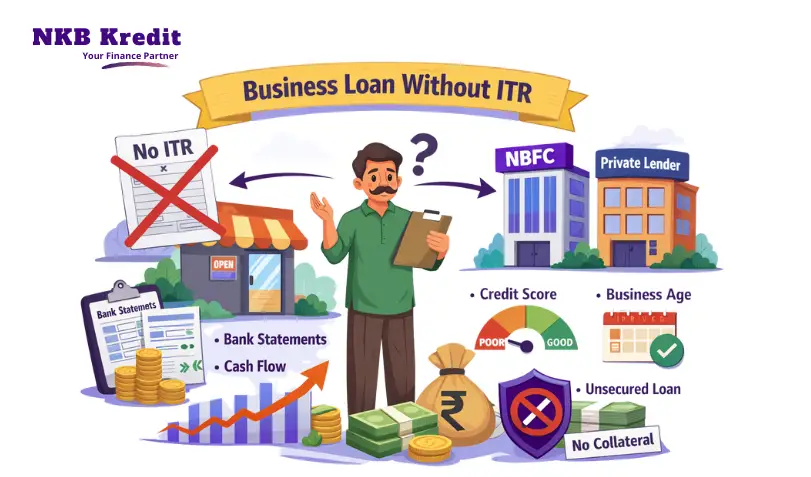
Many small businesses struggle to secure formal credit because they do not have regular income-tax filings. Traders, shop owners, freelancers, and early-stage ventures often rely on cash sales or operate below taxable limits, making traditional documentation difficult.
This has led to growing interest in business loans without ITR in India—facilities where lenders assess eligibility using bank statements, GST data, transaction history, and credit reports instead of income-tax returns.
This guide explains how such loans work, who qualifies, eligibility rules, documents required, limitations, and how lenders evaluate risk—using neutral, fact-based analysis.
Quick Answer
A business loan without ITR is a financing option in which lenders evaluate repayment ability using bank statements, GST filings, digital transactions, and credit bureau reports instead of income-tax returns.
Recent Posts
What Is an ITR and Why Do Lenders Usually Ask for It?
An Income-Tax Return (ITR) records a business’s declared earnings for a financial year. Lenders normally rely on this document to estimate repayment capacity, confirm compliance, and structure loan terms.
Regular filings provide three key signals: predictable income levels, disciplined financial reporting, and legal transparency. Based on this data, lenders decide loan amount, interest rate, tenure, and repayment schedule.
However, not all enterprises maintain complete tax histories. To address this gap, some lenders use alternative data sources—particularly transaction records and banking behaviour—when assessing applications.
Can You Really Get a Business Loan Without ITR?
Yes, but only under specific conditions.
Banks usually insist on income-tax returns for business lending. In contrast, some non-bank lenders rely more heavily on real-time cash-flow evidence. Even when ITR is not required, applicants are still evaluated carefully through other financial records. Lenders typically examine:
- monthly bank inflows and outflows
- consistency of deposits
- digital payment history
- GST turnover (if registered)
- business age and stability
- credit score of promoters
Hot Topics
Interest Rates Are Falling
These loans are often unsecured and therefore come with tighter limits and higher pricing compared to facilities supported by full tax documentation.
How Lenders Assess Risk Without ITR in India
When ITR is unavailable, lenders rely on alternative assessment frameworks commonly used in MSME lending:
- Bank statement analysis to track average monthly credits and volatility
- GST data to validate sales volumes
- Digital transactions such as UPI or card receipts
- Credit bureau reports to examine repayment history
- Industry risk profiling based on sector stability
This multi-layered review replaces the role normally played by income-tax returns.
Business ideas
Business ideas In Tamil nadu
Business ideas In Punjab
Business ideas For Women
Small Business ideas with low Investment
Loans With ITR vs Loans Without ITR
| Feature | With ITR | Without ITR |
|---|---|---|
| Maximum loan size | Higher | Lower |
| Interest cost | Usually lower | Usually higher |
| Tenure | Longer | Shorter |
| Lender profile | Banks + NBFCs | Mostly NBFCs |
| Primary documents | ITR + financials | Bank / GST data |
| Approval comfort | Higher | Moderate |
Business Loan by City
Types of Business Loans Available Without ITR
Several funding structures exist depending on cash-flow patterns.
Unsecured business loans without ITR rely mainly on transaction records and credit scores. These are commonly used for urgent requirements but involve smaller limits.
Short-term working capital facilities are used to fund inventory purchases, payroll, and rent during busy seasons. These depend heavily on monthly cash-flow strength.
Merchant cash advance models base funding on digital sales volume, with repayments linked to daily receipts.
Start-ups or newly established firms may access limited financing if bank activity and promoter profiles appear strong, even without historical tax filings.
Each structure carries different cost and repayment pressures, making product selection important.
Eligibility Criteria for Business Loans Without ITR
Even without tax returns, lenders apply baseline conditions.
Businesses are usually expected to show operating history of at least six to twelve months, consistent banking activity, stable monthly turnover, and reasonable credit scores. Retail shops, service providers, traders, and small manufacturers often fit these profiles more easily than highly volatile enterprises.
Eligibility does not guarantee approval. Final terms depend on overall stability and repayment confidence.
Documents Required for Business Loans Without ITR
Most lenders still request basic proof of operations.
Applicants are commonly asked for six to twelve months of bank statements, identity and address proofs, business registration certificates, GST filings where available, and evidence of business premises such as rent agreements or utility bills.
Providing complete records speeds up assessment and reduces rejection risk.
Who Is Most Likely to Qualify?
This form of financing is typically used by small shopkeepers, self-employed professionals, early-stage businesses, and cash-driven trading units that deposit earnings regularly into their accounts.
Lenders focus less on formal tax filings and more on behavioural signals—transaction regularity, repayment history, and operational stability.
Limitations to Understand Before Applying
These loans involve trade-offs.
Loan sizes are usually lower because annual income cannot be verified through tax filings. Interest costs may be higher due to perceived risk. Repayment tenures are often shorter, increasing monthly obligations. In addition, not all lenders offer such products, narrowing available options.
Understanding these limits avoids unrealistic expectations.
Final Verdict:
Business loans without ITR can provide essential liquidity for enterprises that lack formal tax histories but demonstrate real operating strength through banking behaviour and transaction records.
Strong cash flows, disciplined account usage, transparent documentation, and early planning significantly improve outcomes. These factors matter more than labels when lenders assess risk.
Frequently Asked Questions (FAQs) – Business Loan Without ITR
Yes, it can be possible in specific cases. Some lenders assess eligibility using bank statements, GST data, digital transaction history, and credit reports instead of income-tax returns.
Commonly required documents include 6–12 months bank statements, PAN/Aadhaar and address proof, business registration proof, and GST returns if available. Secured loans may also require property or asset documents.
Lenders typically evaluate monthly bank credits, cash-flow consistency, GST turnover (if applicable), digital payments such as UPI/card receipts, business stability, and promoter credit history.
These loans often have lower ticket sizes, higher interest costs, and shorter tenures compared to loans supported by ITR. Lender options may also be limited.
Sometimes, yes. Newer businesses may qualify for smaller limits if bank activity is consistent and the promoter’s credit profile is strong, but approvals depend on lender policy.